From Dark to Light: Unlocking the Power of Government Environmental Data
By Alicia J. Keyes · March 25, 2026
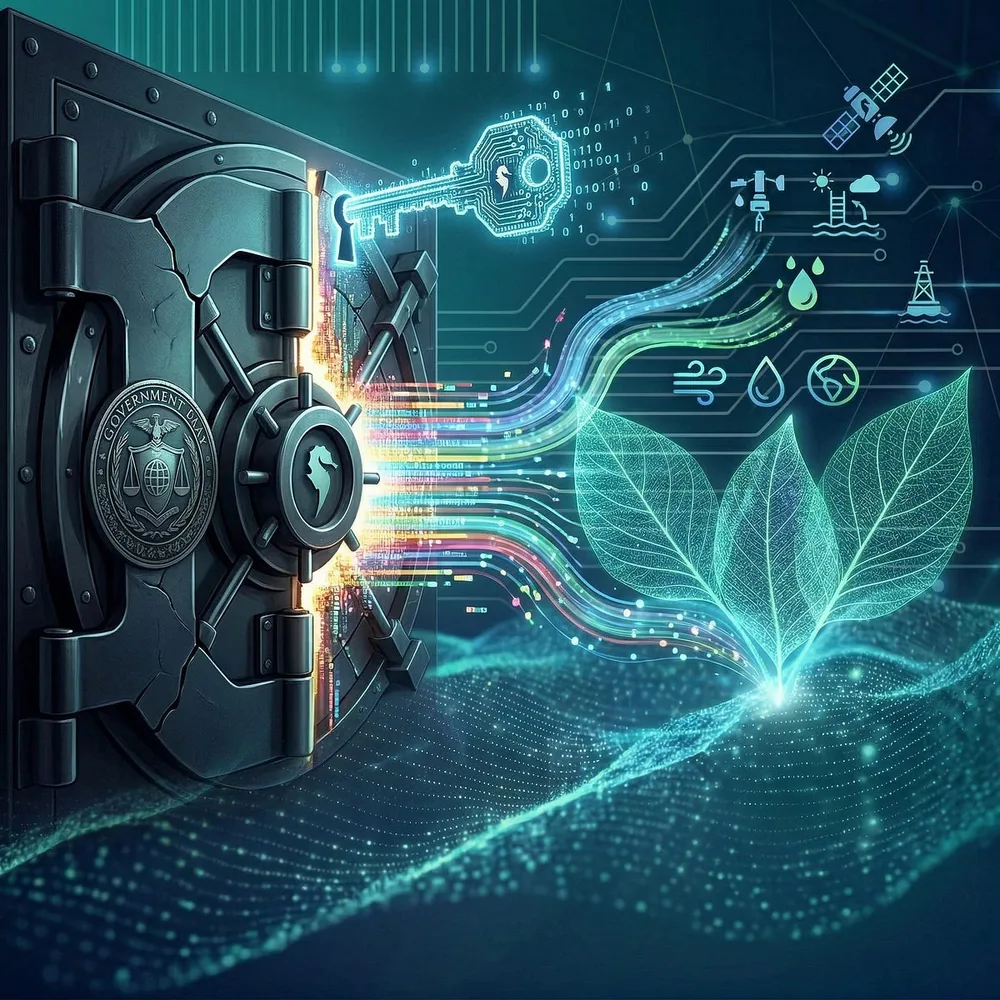
In an era where artificial intelligence and big data are reshaping how information is used and understood, one important set of data remains largely overlooked: government…ental records. Across the country - and especially in environmental and permitting agencies - critical data sits buried in filing cabinets, locked in outdated systems, or preserved in non-scannable PDFs that are functionally invisible to modern technologies. At Apaluma, we call this dark data, and we’re on a mission to bring it into the light.
Why So Much Government Data Is Still in the Dark
Government agencies, especially those tasked with environmental oversight, generate and store immense volumes of data. This includes permits, inspection reports, violation notices, monitoring logs, and more. But much of this data was never created with digital transformation in mind. Over decades, it has accumulated in physical files, faxed forms, scanned images, and PDFs that lack structure or searchability.
Even when digital, the data is often stored in legacy systems that are siloed, difficult to access, or incompatible with modern APIs. And because of limited funding and the sheer scope of historical records, much of this data has never been properly digitized, cleaned, or indexed. As a result, it remains unusable for analysis, automation, or AI.
The Problem with Dark Data
When data is inaccessible, it is also unaccountable. In the context of environmental data, researchers, regulators, and communities can’t see the full picture of environmental conditions, enforcement history, or permitting activity. This opacity creates blind spots in environmental justice, delays in permitting, and missed opportunities for early intervention in pollution or compliance issues.
Dark data also blocks innovation. AI models, machine learning tools, and advanced analytics all depend on structured, machine-readable inputs. Without those, governments can’t leverage the technologies that are already transforming the private sector, and they fall further behind.
The Benefits of Turning Dark Data into Light Data
Light data is clean, structured and searchable. Once transformed, it becomes a foundation for everything from real-time dashboards to predictive analytics and generative AI tools.
By turning dark data into light data, agencies can:
Improve transparency and public trust
Accelerate permitting and compliance workflows
Enable smarter, data-driven decision making
Detect patterns and risks early
Unlock the use of AI copilots and chat interfaces that answer complex questions in seconds
How Apaluma Turns Dark Data into Light Data
At Apaluma, we specialize in the transformation of environmental dark data. Our process combines modern document parsing, OCR, AI-driven entity extraction, and data normalization techniques to turn static documents—like PDFs, scans, and spreadsheets—into structured datasets that can be queried, analyzed, and integrated into modern systems.
We don’t just clean the data—we contextualize it. We map permit data to physical geography, link it with air and water quality metrics, and unify it into a coherent, queryable structure that reflects real-world cause and effect.
This transformation isn’t just technical; it’s foundational. It’s the bedrock of transparency, accountability, and innovation in environmental governance.
Building a RAG Model on Light Data
Once the data is transformed, we use it to power a Retrieval-Augmented Generation (RAG) architecture - a cutting-edge AI framework that brings generative AI and factual accuracy together. Here’s how it works:
Data ingestion: We ingest structured environmental and permitting data into a vector database.
Retrieval: When a user asks a question, the system retrieves the most relevant pieces of factual data.
Generation: An AI model uses those facts to generate a clear, accurate, and context-rich answer.
With our RAG architecture, agencies can deploy powerful AI chatbots that answer staff and public queries with speed and precision. Whether it’s “What permits exist within 5 miles of this school?” or “Has this facility ever violated its discharge limits?”—the answer is now seconds away.
The Power of Real-Time, Integrated Systems
Real-time data isn’t a luxury, it is essential. According to Heavy.ai, a Nvidia backed big data company, “Continuous sensing and near-instant analysis will become the new standard as climate volatility accelerates.” When decisions are made with stale or incomplete data, the consequences can be severe.
Apaluma is the first platform that not only integrates environmental data across air, water, soil, and beyond—but does so in real time, with live feeds, predictive modeling, and historical overlays. More importantly, it shows how human decisions—especially permitted activities—interact with ecosystems.
Originally published on Alicia J. Keyes’ Substack.